Habitat: Eastern Australia, from the tropics of far north Queensland to Tasmania
Scientific name: Ornithorhynchus anatinus
Common names: Duck-billed platypus, Platypus, and Boondaburra, Mallangong or Tambreet (Traditional Owner terms)
Natural predators: Snakes, water rats, goannas, foxes, and crocodiles
Life span: 6—15 years; the maximum life span recorded is 21 years in the wild
Conservation status: Near Threatened under the International Union for Conservation of Nature (IUCN), 2014
Few animals capture the imagination quite like the platypus — a creature so unusual that early European scientists suspected it was a hoax. With their duck-like bill, beaver-like tail, and otter-like fur, the platypus is one of Australia’s most remarkable mammals and a living reminder of the continent’s deep evolutionary history.
The platypus is often described as one of the strangest animals on Earth, and with good reason. Endemic to eastern Australia, this semi-aquatic mammal defies many of the rules that define their class, combining traits that seem borrowed from birds, reptiles, and mammals all at once.
A Mammal That Lays Eggs
Unlike most mammals, the platypus is a monotreme, meaning they lay eggs rather than giving birth to live young. Females lay one to three leathery eggs in a nesting burrow, incubating them by curling their bodies around the clutch. Once hatched, the young (called puggles) are fed milk secreted through specialised mammary glands—without nipples. The milk is released onto the skin, where the puggles lap it up.
Life in Water
Platypuses are adapted to freshwater habitats such as rivers, streams, and lakes. Their dense, waterproof fur provides insulation in cold water, while webbed front feet and flattened tail allow efficient swimming. When diving, platypuses close their eyes, ears, and nostrils, relying instead on one of their most extraordinary adaptations: electroreception.
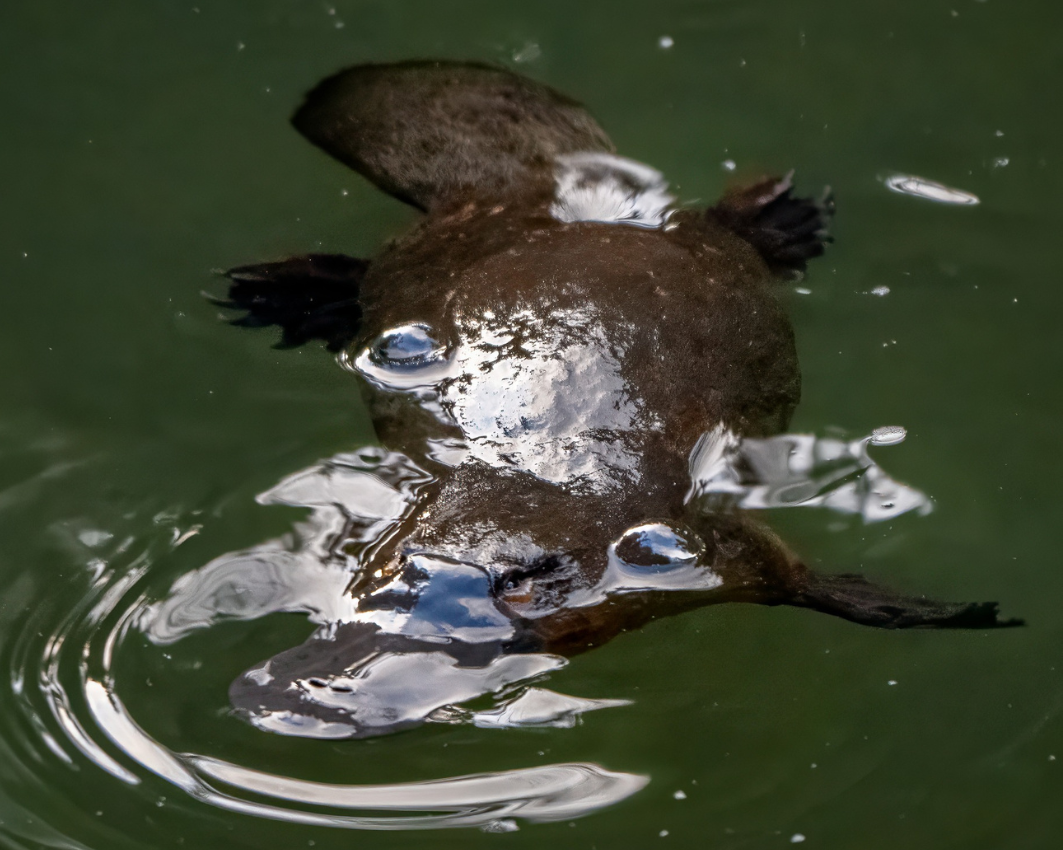
Platypus (Ornithorhynchus anatinus). Image: Steven Nowakowski Panoscapes
Their soft, rubbery bill contains thousands of electroreceptors that detect the weak electrical signals produced by muscle contractions of prey such as aquatic insects, worms, and freshwater crustaceans. This makes the platypus one of the few mammals capable of sensing electric fields.
Venom and Other Oddities
Male platypuses possess venomous spurs on their hind legs, which is a rare trait among mammals. While not lethal to humans, the venom can cause intense and long-lasting pain. The platypus also has a low metabolic rate and maintains a body temperature of around 32°C (90°F). This lower temperature helps them conserve energy, especially when foraging in cold water for long periods.
Conservation and Habitat
Although currently listed as Near Threatened by the IUCN, platypus populations are declining in parts of their range. Major threats include habitat degradation, water extraction, river regulation, pollution, and increasing impacts from climate change, such as droughts and extreme heat events. Protecting healthy, connected freshwater systems is essential for their long-term survival.